
Things To Consider When Choosing a Grill
How Many BTUs Do You Need? Why Altitude and Weather Matter When Choosing an Outdoor Grill
When shopping for an outdoor grill, you'll see BTUs listed prominently in the specifications. It's tempting to compare two grills and assume the one with more BTUs must be hotter, faster, and better.
But that's not necessarily true.
Your ideal grill depends on much more than its BTU rating. The size of the cooking area, grill construction, insulation and heat retention, burner design, altitude, outside temperature, and wind conditions can all affect real-world cooking performance.
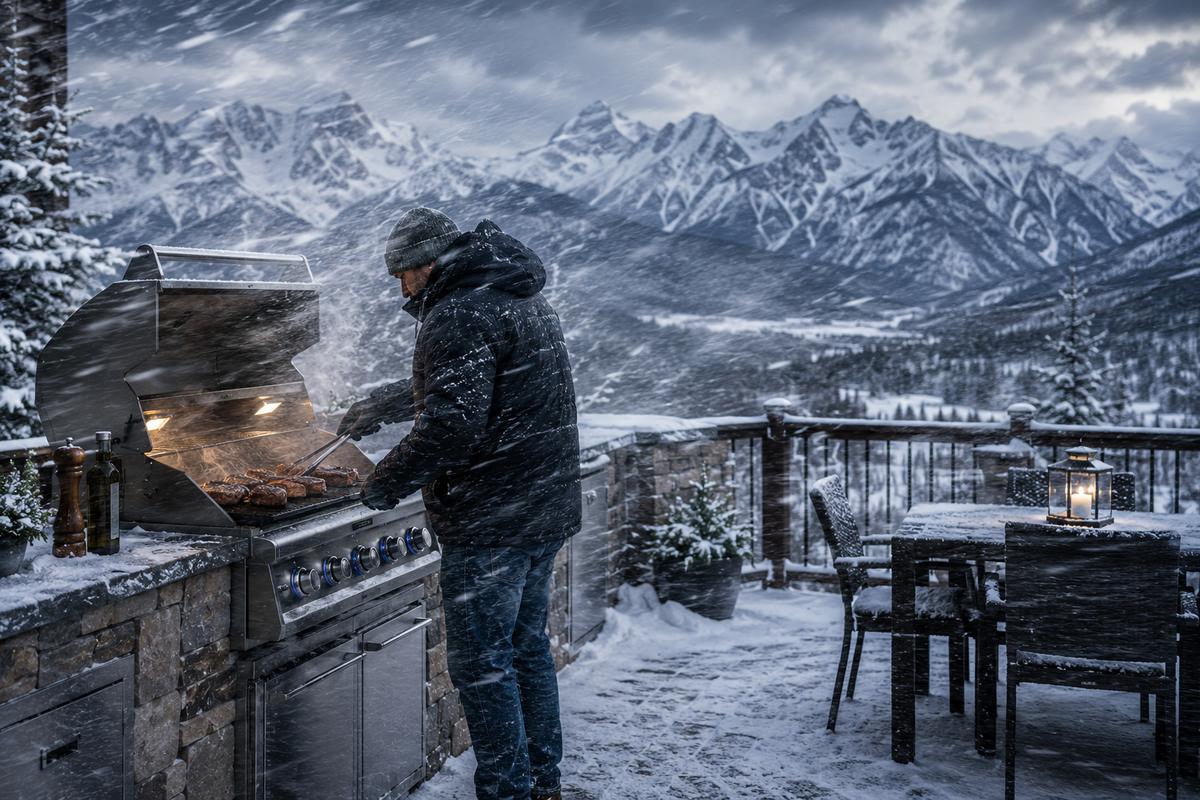
If you live at a higher elevation or regularly grill in cold or windy weather, these factors become even more important.
First, What Is a BTU?
BTU stands for British Thermal Unit, a measurement of heat energy. On a gas grill, the BTU-per-hour rating tells you the heat input of its burners.
A 60,000-BTU grill has a higher total heat input than a 40,000-BTU grill, but that doesn't automatically mean the 60,000-BTU grill will cook your steak better.
Why?
Because you also have to consider how large an area those BTUs are heating and how efficiently the grill retains and distributes that heat.
Think about heating your home. A larger house generally requires more heating capacity than a smaller house. Outdoor grills work on a similar principle: a larger cooking chamber generally requires more energy to heat.
Don't Shop by BTUs Alone
One of the biggest mistakes you can make when comparing grills is choosing whichever model has the largest BTU number.
Instead, consider the entire cooking system.
A well-designed grill with a heavy lid, quality cooking grates, efficient burners, and good heat retention may perform extremely well without having the highest BTU rating in its category.
Conversely, a grill can have an impressive BTU number but lose heat quickly through its construction.
So when comparing grills, consider:
- Total BTUs of the main burners
- Primary cooking-surface area
- Number and placement of burners
- Burner construction
- Cooking-grate material
- Lid and firebox construction
- Heat-retention ability
- Searing capabilities
- Temperature range
- Fuel type
BTUs tell you how much heat energy is being supplied. They don't tell you the whole story about how effectively the grill cooks.
Why Altitude Matters
If you live in places such as Colorado, Utah, Wyoming, New Mexico, Montana, or other higher-elevation areas, altitude deserves special consideration.
At higher elevations, atmospheric pressure is lower and the air is less dense. Gas-burning appliances can behave differently under these conditions, and cooking itself can also take longer in some situations.
For outdoor cooking, that means you shouldn't simply purchase the highest-BTU grill you can find and assume you've solved the problem.
Instead, look for a grill that is approved and properly configured for your location and elevation.
Some gas appliances may require manufacturer-specified high-altitude adjustments, different components, or professional installation depending on the appliance and elevation.
Never modify burners, regulators, gas orifices, or other fuel-system components yourself simply to increase heat output. Follow the grill manufacturer's specifications and local installation requirements.
Higher Altitude Can Also Affect Cooking Time
Even when your grill is operating correctly, cooking at higher elevations may require some adjustments.
Indirect cooking in particular can take longer at higher elevations. This means a roast, chicken, or other food cooked over indirect heat may require additional time compared with the same recipe prepared closer to sea level.
Instead of relying exclusively on the clock, use a quality food thermometer to determine when food has reached its appropriate internal temperature.
Cold Weather Changes the Equation
Do you grill all year?
If the answer is yes, the climate where you live should influence your buying decision.
A grill operating on a beautiful 80°F summer afternoon is dealing with very different conditions than one operating on a 20°F winter evening.
Cold air can increase preheating time and make maintaining cooking temperatures more challenging.
This is where construction and heat retention become especially valuable.
A substantial lid, well-designed firebox, quality grates, and effective heat-management system can help a grill retain the heat its burners produce.
If you're a year-round outdoor cook in a cold climate, don't shop based on BTUs alone. Pay close attention to the physical construction of the grill.
Wind Can Be an Even Bigger Problem
Wind is one of the most overlooked factors in outdoor cooking.
Strong wind can carry heat away from the cooking chamber and interfere with gas-grill performance. In certain circumstances, wind can even contribute to burner problems.
That doesn't necessarily mean you need an enormous grill with enormous BTU output.
It means placement matters.
When designing an outdoor kitchen, consider prevailing winds and follow the grill manufacturer's requirements regarding ventilation, clearances, and installation.
A protected cooking area can perform very differently from the same grill sitting in a consistently windy, exposed location.
Never create an unsafe enclosure around a grill simply to block the wind. Outdoor gas appliances require appropriate ventilation and manufacturer-specified clearances.
Hot Weather Matters Too
Most discussions about outdoor cooking focus on cold weather, but extremely hot climates deserve consideration as well.
If you live somewhere with very hot summers, you may not need additional heating capacity simply because you're cooking outdoors.
Instead, temperature control becomes particularly important.
A grill that gives you good control from lower temperatures through high-heat searing can be more useful than one that's simply designed to produce maximum heat.
This is another reason to look at temperature range and burner control rather than BTUs alone.
What About BTUs Per Square Inch?
You may see shoppers compare grills by dividing total main-burner BTUs by the primary cooking area.
For example:
40,000 BTUs ÷ 500 square inches = 80 BTUs per square inch
This can provide another point of comparison between similarly designed gas grills, but it still shouldn't be treated as a universal rule for determining which grill is better.
Two grills with similar BTUs per square inch can perform differently because of their burners, grates, firebox design, lid construction, ventilation, and heat distribution.
Use BTUs per square inch as one comparison tool—not your final buying decision.
How Many BTUs Should You Look For?
Rather than searching for one magic BTU number, start with your cooking area and environment.
A compact grill designed efficiently for a smaller cooking surface doesn't require the same total BTU output as a large grill with five or six burners and a much larger cooking chamber.
Then consider where you live.
Mild Climate & Lower Elevation
If you typically cook in moderate temperatures with relatively little wind, you can concentrate primarily on cooking area, grill quality, heat distribution, and the features you want.
Cold Climate
If you'll grill throughout cold winters, prioritize heat retention, solid construction, adequate burner performance, and good temperature control.
Windy Location
If your patio or outdoor kitchen is regularly exposed to wind, grill placement and manufacturer-approved installation become especially important. Don't try to compensate for poor placement simply by buying more BTUs.
High Elevation
If you live at higher altitude, verify that the grill is appropriate for your elevation and fuel source and check the manufacturer's high-altitude requirements before purchasing or installing it.
High Altitude + Cold + Wind
This is where careful grill selection really matters.
Instead of simply searching for the largest BTU number, prioritize a well-constructed grill with good heat retention, strong temperature control, appropriate burner performance, and manufacturer support for your elevation.
Propane or Natural Gas?
Fuel source also needs to be part of your decision.
If you're purchasing a gas grill, determine whether you'll use liquid propane or natural gas before you buy. Gas appliances are designed and configured for a particular fuel source.
If you're building a permanent outdoor kitchen with natural gas, make sure the gas supply is properly sized and installed for the appliance by a qualified professional.
If you're using propane, consider your tank capacity and how frequently you cook. Larger, higher-output grills can consume fuel more quickly, particularly when multiple burners are operating at high settings.
Look Beyond the Number on the Specification Sheet
When comparing two grills, don't ask only:
"Which one has more BTUs?"
Ask:
"Which grill will perform best where I live and for the way I cook?"
Consider your:
Altitude + Climate + Wind Exposure + Cooking Area + Grill Construction + Heat Retention + Fuel Source + Cooking Style
Together, those factors tell you much more than BTUs alone.
Choosing the Right Grill for Your Backyard
Someone cooking burgers occasionally in a mild coastal climate has very different needs from someone grilling steaks year-round at 7,000 feet in the mountains.
That's why the "best" grill isn't necessarily the one with the biggest burners.
For everyday family grilling, an efficiently designed moderate-size grill may provide all the performance you need. For a large outdoor kitchen where you're regularly cooking for a crowd, a larger grill with additional burners and greater total heat input may make sense. And for high-altitude, cold, or windy environments, construction, heat retention, installation, and altitude compatibility become especially important considerations.
Buy for Where You Live—and How You Cook
Your outdoor kitchen should be designed for your actual environment, not just for the way it looks in a showroom.
Before purchasing your next grill, consider where you live, your elevation, typical weather conditions, how often you cook outdoors, how many people you feed, and the types of food you enjoy preparing.
BTUs matter—but they're only one part of choosing a great grill.
At LuxLiving-USA, explore outdoor grills and cooking equipment designed for different spaces, cooking styles, and outdoor lifestyles. Compare the entire grill—not just the BTU number—and choose equipment that helps you enjoy outdoor cooking season after season.

Leave a comment
This site is protected by hCaptcha and the hCaptcha Privacy Policy and Terms of Service apply.